
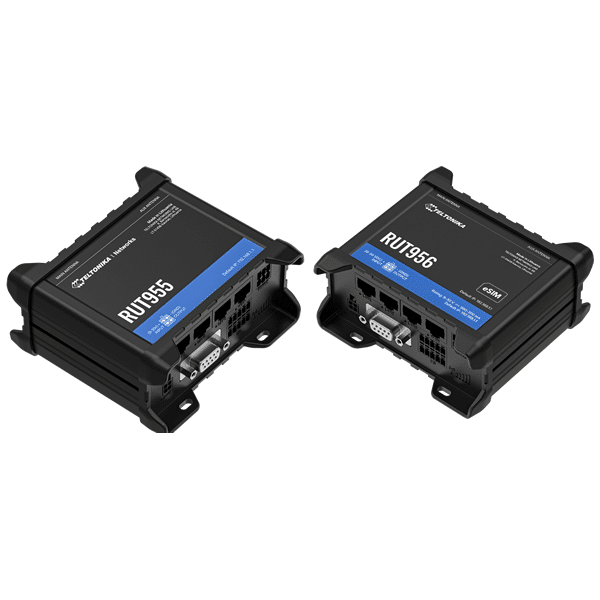
What is the Difference Between the Teltonika RUT955 and RUT956 Models? Leave a comment
For many years, the Teltonika RUT955 defined what an “industrial cellular router” looked like in practice. It was deployed at scale across CCTV networks, building management systems, utilities, transport infrastructure, energy monitoring, and remote industrial sites.

As component lifecycles changed and long-term manufacturing continuity became a priority, Teltonika transitioned the platform to the RUT956. Importantly, this transition was not a reinvention. It was a controlled evolution designed to preserve the characteristics that made the RUT955 successful, while ensuring the platform could continue to be manufactured, supported, and extended for many years.
This paper explains:
- The true technical differences between RUT955 and RUT956
- Why the RUT955 is now end-of-life and how that affects planning
- Why the RUT956 is now the correct platform for new deployments
- How the RUT956’s hardware features are used in real industrial applications
- Why this router class underpins tens of thousands of IoT installations worldwide
1. Lifecycle context: why the RUT955 reached end of life
The RUT955 did not disappear because it failed technically. It reached end of life for the same reason many long-running industrial products do: component availability and long-term supply assurance.
Over its lifespan, the RUT955 went through multiple internal revisions and order-code migrations. This is common in industrial hardware with a long production run. Eventually, maintaining consistent production using legacy components becomes impractical.
From an engineering and procurement perspective, this leads to a clear conclusion:
- The RUT955 remains valid for existing installed bases during its support window
- The RUT956 exists to ensure new deployments are not built on a shrinking hardware platform
This distinction matters. A router is not just a box on a shelf; it is infrastructure that may remain deployed for five, ten, or even fifteen years.
2. Technical comparison: RUT955 vs RUT956 (what actually changed)
Before discussing why the RUT956 is so widely used, it is important to be explicit about what changed and what did not.
2.1 Core platform comparison
| Area | RUT955 | RUT956 | Practical impact |
|---|---|---|---|
| Platform status | End-of-life | Active production | RUT956 is the forward-looking choice |
| Operating system | RutOS | RutOS | Same software ecosystem and logic |
| LTE capability | LTE Cat 4 class | LTE Cat 4 class | No change in speed class |
| Dual SIM | Intelligent dual SIM | Intelligent dual SIM | Same failover logic |
| Ethernet | Industrial 10/100 | Industrial 10/100 | Designed for field equipment |
| Wi-Fi | 2.4 GHz Wi-Fi | 2.4 GHz Wi-Fi | Primarily for access and commissioning |
| Serial | RS232 + RS485 | RS232 + RS485 | Critical for industrial integration |
| I/O | Industrial digital and analogue I/O | Industrial digital and analogue I/O | Enables automation and control |
| GNSS | Yes | Yes | Location, timing, verification |
| Storage | microSD support | microSD support (internal) | Local logging capability |
| eSIM | Not supported | Optional, hardware-dependent | Procurement decision, not automatic |
2.2 What this comparison really tells you
From a functional perspective:
- No industrial capability was removed in the transition
- No automation capability was lost
- No industrial protocol support was dropped
The differences that matter are not about “can it do the job” but about:
- lifecycle certainty
- hardware availability
- and optional future-facing features such as eSIM
3. Software continuity: RutOS as the stabilising layer
Both routers run RutOS, Teltonika’s OpenWrt-based operating system designed specifically for industrial networking.
This matters because RutOS is where most of the real value lives.
3.1 What RutOS provides in practice
RutOS combines several domains that are often split across multiple products:
- Advanced routing and firewalling
- VPN technologies for secure remote access
- Cellular failover logic
- Industrial protocol support
- Event-driven automation
- Fleet-scale remote management
This is why migrating from RUT955 to RUT956 does not feel like learning a new product. The mental model stays the same.
3.2 Configuration reality (important but often misunderstood)
Although the software ecosystem is shared, configuration backups are model-specific. This is not a defect; it is a consequence of hardware identifiers and platform differences.
In practice, professional deployments avoid local backup-restore workflows anyway and instead rely on:
- documented configuration baselines
- templates and profiles
- remote management-driven provisioning
This approach works equally well on RUT955 and RUT956 and scales far better than manual device handling.
4. RUT956 as an application platform (what the features are actually for)
This section replaces the earlier awkward phrasing.
The reason routers like the RUT956 become foundational in large numbers of deployments is not performance. It is operational usefulness.
Each “advanced” feature exists because it solves a real, recurring problem in the field.
4.1 Dual SIM failover that reflects reality
In industrial deployments, connectivity fails in messy ways:
- signal degrades slowly
- networks remain connected but unusable
- roaming causes session drops
- data caps are silently hit
The RUT956 is used because its dual SIM logic can respond to conditions, not just link loss. That reduces site visits and allows engineers to adjust behaviour remotely rather than swapping hardware.
4.2 RS485 and RS232: bridging old and new worlds
A large proportion of industrial equipment still communicates over serial interfaces.
Common examples include:
- energy inverters
- meters
- controllers
- building management equipment
The RUT956 acts as a bridge between these legacy interfaces and modern IP-based systems. This allows serial equipment to be monitored, accessed, and integrated into cloud systems without redesigning the underlying plant.
This single capability is often the deciding factor in product selection.
Read the Teltonika WiKi Page relating to Serial Interfaces
4.3 Digital I/O and automation
Digital inputs and outputs turn the router into more than a communications device.
Typical uses include:
- detecting cabinet door openings
- monitoring alarm states
- triggering external relays
- watchdog automation
Read the Teltonika RUT956 WiKi Page relating to Digital I/O
Power cycling another device (clearly explained)
The RUT956 cannot directly switch high-current or mains power. What it does provide is a reliable control signal.
The correct implementation pattern is:
- Router output triggers an external relay
- Relay switches power to the downstream device
- RutOS automation decides when to trigger the output
Triggers commonly include:
- repeated ping failure
- serial or Modbus state changes
- scheduled actions
- remote commands
This design pattern is extremely common in CCTV, roadside cabinets, remote telemetry, and unmanned infrastructure.
4.4 GNSS: location, timing, and verification
GNSS is used for more than tracking vehicles.
In infrastructure deployments it is often used for:
- verifying installation location
- providing accurate timestamps
- correlating faults with physical position
- supporting compliance and audit trails
When combined with remote management data, GNSS helps engineers distinguish between network problems, site-specific issues, and physical relocation or tampering.
4.5 Security and VPNs as a default, not an add-on
Industrial routers succeed when they assume hostile networks and constrained access.
The RUT956 is widely deployed because secure remote access is built in, not optional. VPNs, firewalling, access control, and segmentation are part of the base platform, not extras that need bolting on later.
This dramatically reduces the long-term cost and risk of operating remote sites.
4.6 Remote management at scale
The final piece is fleet management.
In real deployments, the cost driver is not hardware, it is site visits. A platform that allows engineers to:
- see device health
- change configuration remotely
- diagnose issues without travel
quickly becomes indispensable.
This is where the RUT956 stops being “a router” and becomes infrastructure.
5. Ordering clarity: RUT956 variants and what they mean
The RUT956 is available in multiple order code families. These typically reflect:
- regional cellular band support
- power supply packaging
- optional hardware such as eSIM capability
From a technical buyer’s perspective, the important rules are:
- Always match the regional variant to the deployment geography
- Treat eSIM as a hardware option, not a default feature
- Standardise on a known order code for fleet consistency
The box contents are designed to be deployment-ready, including antennas, connectors, and power accessories appropriate to the selected variant.
6. Why the RUT956 became a cornerstone of IoT connectivity
The RUT956 is not dominant because it is the fastest router available.
It is dominant because it:
- survives harsh environments
- integrates with old and new equipment
- enables automation at the edge
- supports secure remote access by default
- scales operationally across large fleets
Those qualities matter more than headline speed in industrial IoT.
7. Frequently asked questions
What are the main differences between the RUT955 and RUT956?
Functionally, they occupy the same industrial role. The RUT956 replaces the RUT955 as the active production platform, while maintaining the same class of features: dual SIM, serial, I/O, GNSS, RutOS automation, and remote management. The differences are primarily lifecycle-driven and hardware-option-driven rather than capability-driven.
Can the RUT956 power cycle another device?
Yes, as part of an automation system. The router provides control outputs that trigger an external relay. The relay switches the actual power. This is the correct and safe design for industrial deployments.
Is the RUT955 still usable?
Yes, for existing installations within its support window. However, it is no longer appropriate for new deployments where long-term availability and future expansion matter.
Does the RUT956 support eSIM?
eSIM support is optional and depends on the specific hardware variant ordered. It must be specified deliberately during procurement.
Is the RUT956 difficult to migrate to from RUT955?
No. The operational concepts are the same. The main adjustment is configuration management discipline rather than feature re-learning.
Final perspective
The transition from RUT955 to RUT956 is best understood as platform continuity, not disruption.
For new deployments, the RUT956 is the correct choice because it preserves everything that made the RUT955 successful while providing a stable foundation for future-proof industrial connectivity.
That is why it continues to sit quietly underneath tens of thousands of IoT systems, doing its job without drawing attention to itself.
